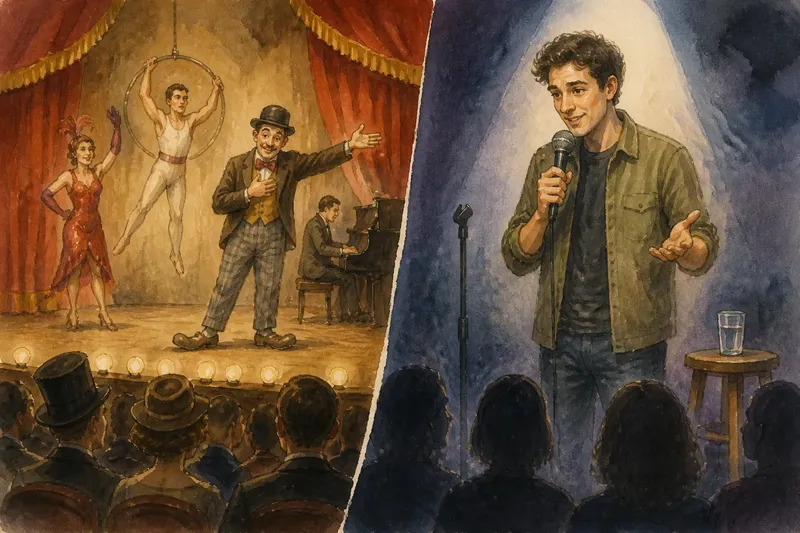
The Turn That Makes a Punchline Feel Inevitable
Learn how a punchline can surprise and still feel earned by tracing its setup, the audience’s expectation, and the precise detail that redirects it.

A friend says, “I bought a smart speaker so I’d have someone to talk to.” The line has already suggested a familiar scene: a person lonely enough to address a device. Then comes the turn: “Now I’m lonely in a room with excellent customer support.” The punchline redirects the setup without abandoning it. That is how a punchline can feel inevitable: the surprise changes the interpretation, while the opening has quietly supplied the materials for that change.
To build that effect, treat a joke as a small act of expectation management. The opening invites the audience toward one reading; the turn gives them a better, less obvious reading that fits what they already heard. These five decisions help you make the shift feel both unexpected and earned.
1. What expectation does the opening establish?
A setup does not need to explain a whole situation. It needs to give the audience a usable first interpretation. In “I bought a smart speaker so I’d have someone to talk to,” the phrase “someone to talk to” points toward loneliness and companionship. The audience begins filling in the ordinary emotional story before the punchline arrives.
Write the opening in plain language, then ask what a listener would predict next. A prediction might be an obvious complaint, a sentimental admission, or a familiar observation about technology. The useful prediction is not necessarily the only possible one; it is simply the path the wording makes easiest to follow.
That path is the joke’s expectation. If the setup is too vague, the audience has nothing definite to anticipate. If it spells out the entire premise, there is little room for a turn. Aim for enough information to establish a direction, but leave the ending open.
- Underline the words that point toward the expected interpretation.
- Write down the most ordinary continuation a listener might anticipate.
- Remove background details that do not help establish that expectation.
For instance, if a line begins, “My new planner is helping me get organized,” a likely expectation is a routine success story or a gripe about falling behind. If the intended punchline concerns the planner’s intimidating blank pages, “new” and “organized” may provide enough groundwork; a paragraph about where it was purchased probably does not.
2. What is the opening quietly promising?
The setup’s promise is more specific than its subject. “A smart speaker” announces a gadget, but “someone to talk to” promises a joke about companionship. That distinction matters: a punchline about the device’s weather forecast might be amusing, but it would not deliver on the emotional expectation the opening created.
Try describing the setup’s promise in one sentence: “This will be about a lonely person seeking company,” or “This will be about an organized person losing control.” Then list a few possible ways to fulfill that promise. The first continuation will often be familiar. Keep searching for a consequence that belongs to the same promise but arrives from an unexpected angle.
The line about “excellent customer support” keeps the loneliness premise in view, but shifts its frame. The speaker has not found human company; they have found a service relationship. The sharper phrasing makes the emotional situation sound like a product feature, a mismatch that grows directly out of the original expectation.
When a punchline feels pasted on, check the promise before polishing individual words. A clever tag may not rescue a setup that points toward a different subject. Reworking the opening can make the eventual turn feel connected without explaining it for the audience.
3. What precise change redirects the meaning?
A strong turn often depends on one small change in category, motive, scale, or point of view. The audience begins by assigning a word or situation one meaning; the punchline asks them to revise that assignment. In the smart-speaker line, “talk to” first suggests reciprocal companionship, then “customer support” reframes the exchange as a service interaction.
Look for a hinge word or detail that can support both readings. Common hinges include “help,” “support,” “available,” “commitment,” and “personal.” Their usefulness comes from having ordinary meanings in several contexts, not from being funny on their own. A hinge works only when the setup makes one reading natural and the punchline makes another reading newly relevant.
Imagine a character saying, “I started keeping a food journal to understand my habits.” The expected reading is that the character wants to improve their eating. A turn might reveal, “It’s mostly a record of the snacks I call dinner.” The ending redirects “understand my habits” toward a gap between the character’s self-description and their actual routine. The joke retains the journal premise while making the character’s language part of the comic problem.
To find a turn, ask what else the key phrase could mean, what unexpected motive could explain the same action, or what small detail would expose a contradiction. Avoid changing the subject just to produce novelty. The audience should be able to look back at the opening and recognize why the new interpretation belongs there.
4. How can the turn be surprising without becoming random?
Surprise comes from withholding the less obvious reading until the last useful moment. Earned surprise comes from having planted enough information for the audience to recognize that reading once it appears. If the punchline depends on a new person, place, or fact that the setup never made relevant, the audience may understand the words but feel that the joke changed tracks.
A practical check is to read the setup and punchline together, then ask, “What in the opening makes this ending possible?” The answer should point to a word, implied motive, relationship, or circumstance already present. If you have to invent a long explanation after the punchline, the connection may be too weak.
Say you are writing about a character who says, “I joined a book club to become more social.” The expected direction is a story about meeting people or discussing novels. An invented turn could be, “Now I have four acquaintances who know I didn’t finish the book.” The ending remains tied to the club and the character’s social aim, but redirects attention from literary conversation to the awkward evidence of not participating. Its surprise comes from the social consequence, not from an unrelated twist.
Sometimes the missing link is in the setup rather than the punchline. Add one concise detail that makes the intended interpretation available, or replace a broad phrase with a more precise one. Do not add a full explanation of the turn; that makes the audience receive the answer before it can arrive as a discovery.
5. Which words should carry the turn?
Place the most important reinterpretation near the end of the sentence. Listeners process a joke as it unfolds, so a punchline that announces its sharpest detail early may leave the remaining words to flatten the effect. The final phrase should carry the new reading whenever the sentence can do so without sounding strained.
Compare “Now I’m lonely in a room with excellent customer support” with “The smart speaker has excellent customer support, which is where I now experience loneliness.” The second version explains the connection before it reaches the strongest contrast. The first saves “customer support” for the turn and lets the audience connect the service language to the setup’s promise of companionship.
Read the line aloud and mark where a listener first has enough information to understand the turn. Words after that point may be unnecessary, unless they add a fresh consequence. Cut repeated explanations, soft introductory phrases, and details that merely report what the punchline already implies.
Economy is not the same as making every sentence short. A longer setup can build a useful expectation, especially when a character’s particular habits matter. The test is whether each phrase strengthens the audience’s prediction, makes the turn possible, or improves the line’s sound.
6. What should you listen for when revising?
Read a draft aloud to someone who has not seen it, or record yourself and listen without looking at the page. Notice where the listener seems to form a prediction, whether the punchline changes that prediction, and whether the wording leaves room for the connection to register. A response alone cannot tell you exactly what is working, but the shape of the line often becomes clearer in performance.
If listeners understand the setup but anticipate the punchline, the turn may be too familiar or signaled too early. Preserve the core promise, then try a less obvious consequence or a different hinge. If they understand the words but cannot see why the ending belongs, strengthen the setup’s relevant clue rather than adding an explanation after the punch.
If the line receives a laugh but feels like a different joke from the one the opening proposed, inspect the connection anyway. A surprising detail can get a reaction while leaving the original expectation unused. Revisions that honor the setup tend to give the audience a more satisfying moment of recognition.
What questions help diagnose a punchline’s turn?
What is the difference between a setup and a punchline?
The setup establishes a situation and directs the audience toward an expected interpretation. The punchline redirects that interpretation with a detail that makes sense in the situation but was not the easiest prediction.
How do I make a punchline less predictable?
Keep the setup’s promise, but search for a less familiar consequence, motive, or second meaning in its central phrase. Avoid hiding the joke by making the setup unclear; the audience needs a clear expectation for the turn to disrupt.
Why does a punchline feel random?
The ending may introduce information that the opening did not make relevant, or the setup may point toward a different kind of joke. Find the missing connection in an existing word or add one brief clue before the turn.
Where should the punchline go in a sentence?
Put the detail that changes the audience’s interpretation as late as natural phrasing allows. Read the sentence aloud to make sure the final wording sounds like something the character would say, not a punchline forced into position.
How do you know the turn is earned?
Trace the line backward from its final phrase. If the opening supplies a clear expectation, the ending changes that expectation through a detail already made relevant, and no extra explanation is needed, the turn has a sound structure. The audience can be surprised in the moment and still recognize the path that brought them there.
When revising, protect that path before chasing a bigger twist. A punchline that feels inevitable does not make the audience predict the ending; it makes the ending, once heard, feel like the most revealing way to read the opening.