Deadpan or Animated: Two Routes Through the Same Line
Deadpan or animated delivery changes how an audience reads the same joke. Learn to shift emphasis, shape character, and choose a performance that fits.
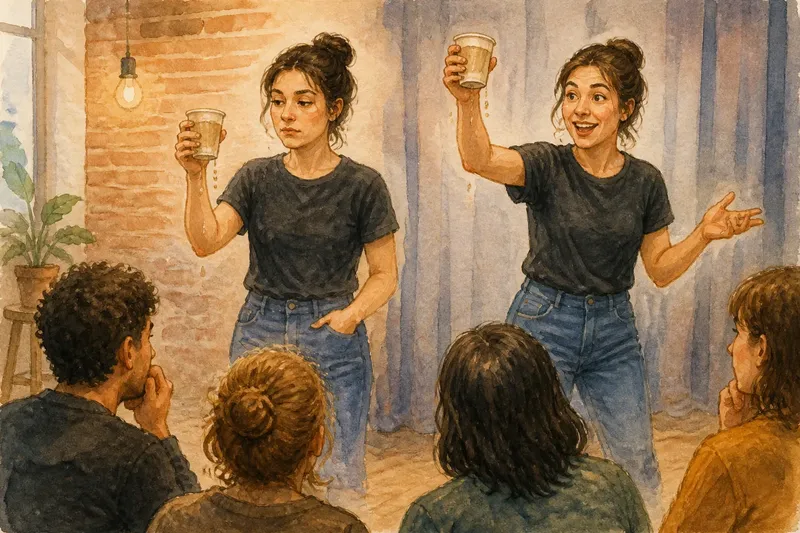
At a neighborhood comedy workshop, a performer holds up a paper cup with a damp bottom and says, “This coffee has a very strong sense of adventure.” The sentence is mild enough to disappear into conversation—or become a small, ridiculous complaint—depending on what the performer does with the face, voice, and pause around it. Deadpan or animated delivery does not change the words; it changes what the audience thinks those words are doing.
Imagine a fictional performer named Mara preparing this line for a short scene about a café that keeps serving leaky cups. She wants to decide whether the character is quietly absurd or openly delighted by the absurdity. The useful question is not which style is funnier in the abstract, but which reading makes the line belong to this person in this moment.
What does deadpan ask the audience to notice?
Mara first tries the line with a steady gaze and an even voice. She lets “strong sense of adventure” pass without a wink, then looks at the cup as if assessing an ordinary inconvenience. The joke’s friction sits between the grand description and the unimpressive object.
That restraint asks the audience to do a little interpretive work. They hear the figurative phrase, compare it with the leaking cup, and supply the recognition that the speaker is treating a small annoyance with mock seriousness. The performer does not announce the joke; the mismatch does.
Deadpan is not simply a blank face or a quiet voice. If Mara’s expression becomes vacant, the audience may read indifference rather than control. A small, attentive look can be more useful: the character appears to take the cup seriously, which makes the inflated wording feel like a private rule of thought.
With this approach, timing often comes from withholding a signal. Mara can finish the sentence, allow the cup to drip, and keep her eyes on it. The pause gives the image room to register, but an overly long hold may turn the moment into a request for laughter. The right duration depends on the scene’s pace and how clearly the audience can see the cup.
What changes when the delivery becomes animated?
For the second pass, Mara brightens at “strong sense,” lifts the cup as if introducing a brave explorer, and gives “adventure” a cheerful flourish. The same sentence now sounds less like a dry verdict and more like a person enthusiastically narrating a minor disaster.
The emphasis moves from the gap between language and object to the character’s pleasure in making that gap larger. Her gesture supplies a point of view: perhaps she turns inconvenience into a story because ordinary life feels too small without narration. The audience is invited to enjoy the speaker’s performance as well as the image of the cup.
Animation can sharpen a word, but it can also overwhelm it. If Mara waves the cup, changes her voice, raises her eyebrows, and adds a broad reaction all at once, the sentence has several competing centers. Choosing one main accent—perhaps the ceremonious lift on “adventure”—lets the rest of the line remain legible.
This version also changes the character’s relationship with the audience. The bright delivery can feel conspiratorial, as though the speaker wants company in turning a leak into an expedition. A restrained version may leave the audience to discover the joke without being personally recruited. Neither reading is fixed by the wording alone.
How does Mara choose a version for the scene?
Mara now considers what happens before and after the line. In the invented scene, her character has been trying to act like an exacting café critic, making elaborate judgments about ordinary things. A controlled delivery supports that self-image: she treats the cup’s failure as though it deserves formal consideration.
But suppose the scene has established that the character narrates everything with theatrical excitement. Then the animated version may fit better, because the same flourish is part of how this person interprets a dripping cup. The line should feel like an extension of the character, not a detachable display of comic energy.
She also considers what the scene needs at that instant. If the preceding exchange is already loud and physical, a calm line can change the texture and draw attention through contrast. If the scene has been quiet and still, a sudden burst of ceremony can provide a clean shift. This is not a rule that calm must follow noise; it is a choice about which change the moment can carry.
For a rehearsal pass, Mara marks three things in the script: the word she wants to emphasize, the physical behavior that supports it, and the instant when she returns to listening. In the restrained version, the emphasis is carried by the mismatch and the listening remains still. In the animated version, the gesture peaks on “adventure,” then settles so the next line can begin without a second punchline competing for attention.
Which delivery choices do performers often ask about?
Does deadpan mean never changing expression?
No. A small shift in attention can make a restrained performance readable: Mara might look from the cup to the listener only after the sentence. The point is to keep the reaction economical, not to remove all signs of thought.
Does animated delivery require a big gesture?
No. A lift of the cup or a precise change in vocal pitch can carry the character’s enthusiasm without broad movement. The gesture should clarify the point of view, rather than decorate every word.
Can the same line work both ways?
Yes, if each delivery gives the sentence a coherent intention. A performer can try both readings in rehearsal and notice whether the audience understands the character’s attitude, not merely whether the line receives a reaction.
How can a performer keep a pause from feeling forced?
Give the pause an activity: look at the leak, reconsider the cup, or wait for a companion to respond. When the character has something to attend to, the silence belongs to the scene instead of seeming like a timer set for laughter.
What does the finished version reveal?
In this imagined workshop, Mara settles on the restrained delivery for the first scene. The character’s formal seriousness makes the coffee line sound like a considered judgment, and the audience can see the damp cup while she remains composed. Later, when the character tries to cheer up a companion, Mara uses the animated version: the same words become an invitation to laugh together at the small mishap.
The two passes have not uncovered a single correct performance. They have shown how delivery assigns emphasis: deadpan lets the discrepancy take the lead, while animation foregrounds the speaker’s appetite for the joke. For anyone weighing deadpan or animated delivery, the practical test is to ask what the character believes the line is doing, then let voice, face, and gesture support that reading. The words can stay still while the relationship around them changes.