From Vaudeville Turn to Solo Mic
See how the vaudeville turn and solo comic monologue differ, and use a clear comparison to choose the right shape for a short performance.
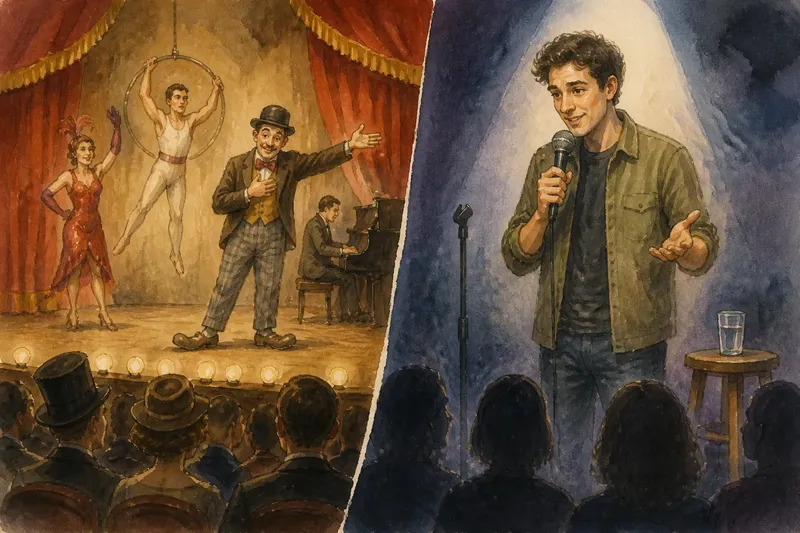
A comic stepping onto a vaudeville bill could follow a singer or acrobat and then make room for another act. A solo comic at a microphone has no such handoff. The contrast is a useful way to think about two performance forms, without treating it as a complete history of how one replaced the other.
What defines a vaudeville turn?
Vaudeville was built around a varied bill: different performers and kinds of entertainment appeared in succession. A comic’s turn was one bounded part of that program, with an entrance, a distinct act, and an exit that cleared space for what followed.
That slot rewarded a quickly legible comic identity. Costume, stance, patter, or a sharply framed premise could tell an audience what kind of performer had arrived. The act did not have to create the entire evening’s range; the bill supplied contrast through its other performers.
How does a solo mic set differ?
A solo set asks one performer to provide the changes of pace. The comic may move from a short joke to a story, or from one subject to another, while keeping the audience oriented to the same speaker.
That does not mean every bit needs a shared theme or a spoken bridge. The audience can follow a set through the performer’s recognizable way of interpreting events: what they notice, what they misunderstand, or how they react when plans go wrong. The form depends less on a sequence of different acts and more on one person’s changing material.
What does the contrast mean for a performer?
Think of the vaudeville turn as a useful craft analogy: it draws attention to the boundary and identity of a short act. The solo set adds a separate question—how the next piece feels after the one before it. These are different design problems, even when the same performer uses both kinds of thinking.
For a short showcase slot, a clear premise and a deliberate ending may be enough to make a piece feel complete. For a longer solo performance, the order of material matters too. A quieter story after a run of quick jokes can change the room’s pace; a recurring detail can make a later bit feel connected without forcing all the material onto one subject.
How can you choose the right shape for a short set?
Start with the setting and the job the material needs to do. A tightly bounded slot on a mixed bill may call for a self-contained turn. A longer solo performance can make more room for variation, callbacks, and shifts in pace.
- Check the event format: if performers have separate short slots, then shape a self-contained act; if you have a longer solo slot, then plan how the material changes pace.
- Check whether the opening premise is clear without earlier context: if it is, then it can stand near the start of a short turn; if not, then add the needed setup or place it after relevant material.
- Check the ending: if the last joke or image gives the piece a clear stopping point, then keep it as the exit; if it trails into another topic, then revise the ending or move that topic elsewhere.
- Check the material’s dependence on a previous bit: if it makes sense alone, then it can suit a mixed-bill slot; if it relies on an earlier detail, then place it later in a solo set or supply that context.
- Check the pace of neighboring pieces: if two adjacent bits ask for the same energy, then consider separating them with a different kind of material; if their similarity is intentional, then make the escalation clear.
- Check the performer’s point of view across the set: if different subjects still reveal a recognizable sensibility, then the sequence can turn freely; if they feel unrelated, then add a genuine connection or change their order.
Say you have a short showcase slot and three pieces: a joke about revising a coffee order, a story about trying to sound competent at work, and a closing image about a printer refusing to cooperate. The coffee joke and work story both turn on over-editing, so you place them together and let that shared habit carry the transition; the printer piece has no such link, so you either give it a clear standalone setup and use it as the closer or leave it out. The result is a compact turn with a recognizable idea and an ending that does not depend on an unspoken connection.
What questions help distinguish the forms?
Is a vaudeville turn the same as a solo set?
No. A vaudeville turn was a bounded act within a varied bill, while a solo set places one performer in charge of a larger stretch of attention. A solo comic can still build individual pieces with the clarity of a short turn.
Does a solo mic set need one subject?
No. It can move among subjects if the audience can still recognize the performer’s perspective. A repeated attitude or way of noticing can provide that thread without making every bit about the same topic.
When does a short act need a self-contained ending?
It needs one when the performance slot ends there and no later material will complete the thought. In a longer solo set, a bit can also hand attention to the next piece, provided the transition makes sense to the audience.
Can a performer use vaudeville’s variety in a solo show?
Yes. A solo performance can vary its pace, subject, and delivery while one performer remains the point of continuity. The difference is that the performer, rather than a succession of other acts, supplies those changes.
Which form should guide your next draft?
For a self-contained slot, ask whether the audience can understand the premise and recognize the ending without relying on material outside the turn. For a longer solo set, ask how each piece changes the pace or reveals another facet of the performer. The phrase vaudeville turn to solo mic is most useful as a comparison between those two tasks, not as a claim that one form simply became the other.
When a bit seems to belong nowhere, check its intended job before rewriting it: is it meant to stand alone, or to gain meaning from its place in a larger performance? That answer can tell you whether to sharpen its boundaries, move it, or let it go.